


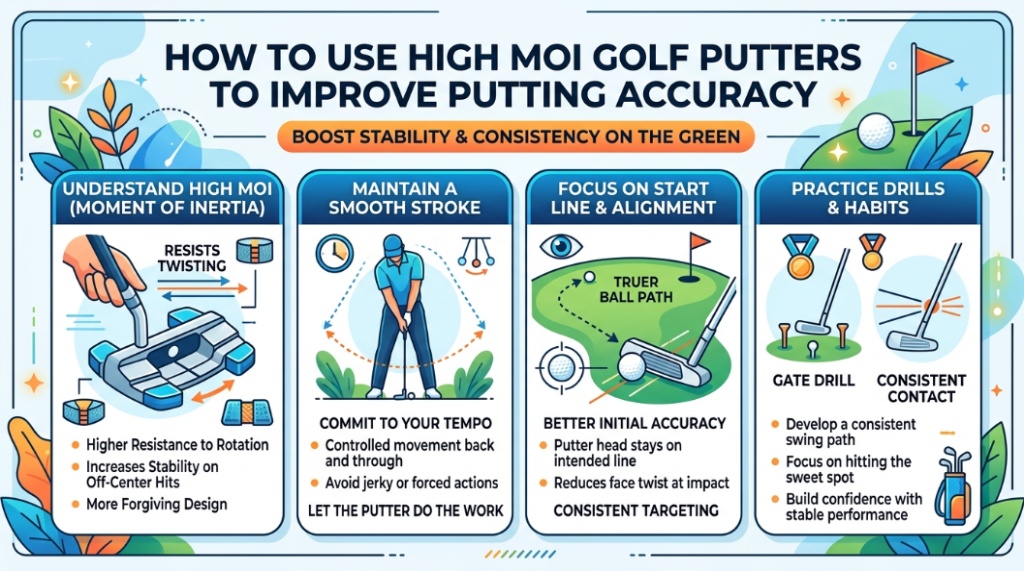
High MOI golf putters improve putting accuracy by resisting twisting on off-center strikes, helping the clubface stay square through impact and producing more consistent roll and distance control.
Why do golfers struggle with putting accuracy—and how can high MOI putters fix it?
Most missed putts are not caused by poor reads—they’re caused by inconsistent face alignment and off-center strikes. Even small mishits can send the ball offline, especially under pressure. That’s where high MOI golf putters make a measurable difference.
High MOI (moment of inertia) putters are designed to stabilize the clubhead during impact. Instead of twisting when contact isn’t perfect, they maintain alignment and preserve energy transfer. This results in straighter starts, better distance control, and fewer three-putts.
In practical terms, golfers using high MOI putters often see improved consistency within 10 feet—the range responsible for most scoring differences. Whether you’re a beginner building fundamentals or an experienced player tightening dispersion patterns, switching to a high MOI design can significantly improve putting reliability.
Definition: A high MOI golf putter is a stability-focused putter engineered with perimeter weighting to reduce face rotation on mishits and improve directional consistency.
What does MOI mean in golf putters?
MOI in golf putters refers to resistance against twisting during impact. Higher MOI means the clubhead stays more stable when the ball is struck away from the center.
Moment of inertia measures how much a putter resists rotation around its axis. When a putter twists during contact, the face opens or closes slightly. That small movement changes the ball’s starting direction.
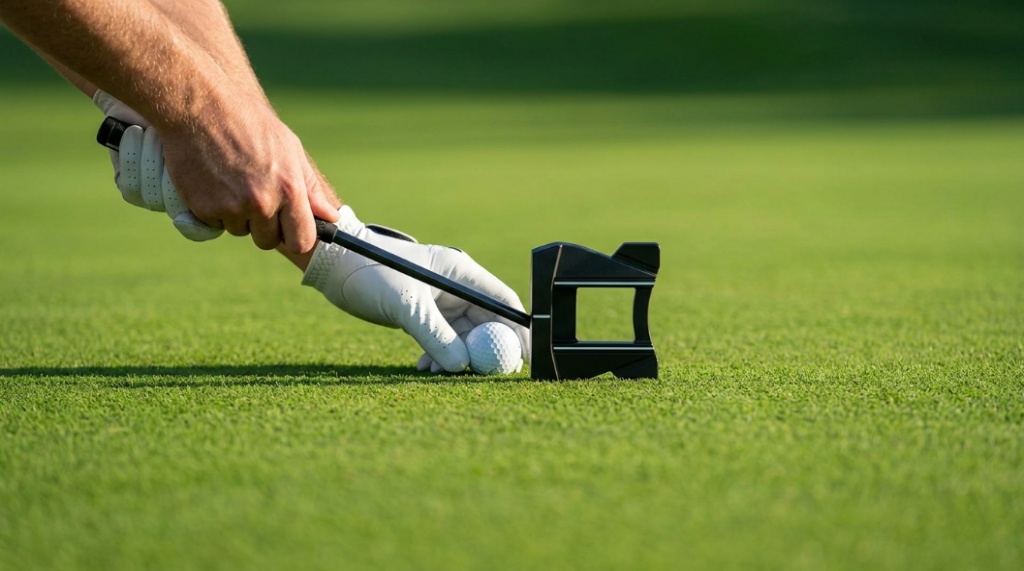
High MOI putters solve this problem by distributing weight farther from the center of the head. Common design strategies include:
- Perimeter weighting
- Winged mallet structures
- Multi-material construction
- Rear-weight positioning
- Expanded head geometry
Launch monitor testing consistently shows that face angle at impact contributes over 80% of a putt’s starting direction. That makes MOI one of the most important performance variables in modern putter engineering.
How do high MOI golf putters improve accuracy on off-center hits?
High MOI putters improve accuracy by maintaining face alignment and preserving ball speed during mishits.
Off-center contact causes two problems:
- Face rotation (directional error)
- Energy loss (distance inconsistency)
High MOI designs reduce both.
When weight sits at the perimeter instead of the center, the putter resists torque. This keeps the face square longer through impact. As a result:
- Heel strikes stay online
- Toe strikes lose less distance
- Face angle deviation decreases
- Start-line consistency improves
This matters most on medium-length putts between 6 and 15 feet—where accuracy determines scoring performance.
Who benefits most from using high MOI golf putters?
Golfers with inconsistent strike patterns, alignment issues, or slower stroke tempo benefit most from high MOI putters.
These putters are especially effective for:
- Beginner golfers learning stroke mechanics
- Mid-handicap players reducing three-putts
- Players with arc instability
- Golfers struggling with distance control
- Anyone missing short putts under pressure
Even elite players use high MOI mallet putters because forgiveness improves performance during competitive rounds.
Tour adoption of stability-focused putters has increased steadily over the past decade as launch monitor data confirmed their benefits.
Why are mallet putters usually higher MOI than blade putters?
Mallet putters have higher MOI because their larger heads allow weight to be positioned farther from the center.
Blade putters traditionally place most mass near the face center. Mallet designs distribute weight outward and backward.
| Feature | High MOI Mallet Putters | Traditional Blade Putters |
|---|---|---|
| Forgiveness | High | Moderate |
| Face stability | Excellent | Lower |
| Alignment assistance | Strong | Minimal |
| Consistency on mishits | High | Lower |
| Preferred stroke type | Straight-back-straight-through | Arc stroke |
That doesn’t mean blades are ineffective. Many skilled players prefer them for feel and feedback. But stability advantages make mallet-style high MOI putters more forgiving overall.
How should you align a high MOI golf putter correctly?
Align a high MOI putter by using its built-in visual guides to square the face before starting your stroke.
Most high MOI putters include alignment aids designed to simplify setup. These may include:
- Topline sightlines
- Contrasting color channels
- Rear alignment rails
- Ball-width reference markings
To improve accuracy:
- Position the putter face first
- Set your stance second
- Confirm shoulder alignment last
This sequence prevents compensations that create inconsistent stroke paths.
What stroke style works best with high MOI golf putters?
A straight-back-straight-through stroke works best with most high MOI putters, especially face-balanced models.
Face-balanced putters resist rotation during the stroke. This complements players who naturally move the putter on a straighter path.
If your stroke has minimal arc, high MOI designs support:
- Square face control
- Smooth tempo
- Repeatable contact
Golfers with strong arc strokes can still benefit, especially when using toe-hang mallet designs.
How can high MOI putters improve distance control?
High MOI putters improve distance control by preserving ball speed across the face.
Traditional putters lose speed when impact occurs away from the sweet spot. High MOI designs reduce this loss.
That means:
- Short putts stay consistent
- Lag putts finish closer
- Speed dispersion narrows
- Three-putts decrease
Modern inserts and face milling technologies further enhance roll consistency.
Are high MOI golf putters better for beginners?
Yes, beginners benefit from high MOI putters because they reduce the impact of stroke errors and mishits.
New golfers often struggle with:
- Face control
- Strike location
- Tempo variation
- Alignment accuracy
High MOI putters provide forgiveness in all four areas.
This helps players build confidence faster while improving fundamentals.
How do professionals use high MOI putters differently than amateurs?
Professionals use high MOI putters to tighten dispersion patterns rather than correct major stroke flaws.
Tour players already strike the center frequently. Their focus is precision under pressure.
They rely on high MOI designs for:
- Start-line reliability
- Consistency on fast greens
- Reduced face rotation
- Confidence inside 8 feet
Performance gains may be subtle but meaningful during competition.
What features should you look for when choosing a high MOI golf putter?
Choose a high MOI putter with strong perimeter weighting, clear alignment aids, proper shaft balance, and comfortable head size.
Key selection criteria include:
- Head geometry stability
- Alignment visibility
- Face insert responsiveness
- Weight distribution
- Grip size compatibility
Multi-material putters using aluminum, stainless steel, and tungsten often achieve higher MOI ratings.
Does putter length affect performance with high MOI putters?
Yes, proper putter length ensures consistent eye position and stroke path control.
If the putter is too long:
- Eyes move inside target line
- Face control decreases
- Distance consistency drops
If too short:
- Posture tightens
- Stroke arc changes
- Tempo becomes unstable
Correct length improves the effectiveness of high MOI stability benefits.
How can you practice effectively with a high MOI golf putter?
Practice with start-line drills, distance ladders, and centered-strike exercises to maximize the advantages of high MOI putters.
Recommended drills include:
Start-line gate drill
Place two tees slightly wider than the putter head. Roll putts through the gate to train face alignment.
Distance ladder drill
Putt balls to incremental targets at increasing distances.
Centered contact drill
Apply impact tape to verify strike consistency.
These exercises reinforce the stability benefits built into high MOI designs.
Conclusion: Should you switch to high MOI golf putters to improve accuracy?
High MOI golf putters improve putting accuracy by stabilizing the clubface, preserving ball speed, and reducing directional errors on mishits. For most golfers, especially those seeking consistency inside scoring range, they offer measurable performance advantages.
Modern putter engineering increasingly prioritizes forgiveness because even elite players benefit from stability under pressure. Whether your goal is fewer three-putts or better short-range confidence, a properly fitted high MOI putter can transform your putting results.
If your current putter produces inconsistent start lines or distance gaps, testing a high MOI design is one of the simplest equipment upgrades you can make.
FAQ: High MOI Golf Putters
Do high MOI golf putters really make a difference?
Yes. High MOI putters reduce face twisting on off-center strikes, improving directional consistency and distance control across the putting surface.
Are high MOI putters better for short putts?
Yes. Stability improves face alignment at impact, which increases accuracy inside 10 feet where most strokes are gained or lost.
Can high MOI putters help reduce three-putts?
Yes. Better speed retention on mishits improves lag putting distance control, lowering the likelihood of leaving long second putts.
Do high MOI putters feel different from blade putters?
Yes. They typically feel more stable and balanced through impact, though some players perceive slightly less feedback from the face.
Should high-handicap golfers use high MOI putters?
Yes. High-handicap players benefit significantly from forgiveness and alignment assistance built into high MOI designs.
Are face-balanced putters always high MOI?
No. Many face-balanced putters have high MOI, but MOI depends primarily on weight distribution rather than shaft balance alone.
Read More Also: Durability Test: LOSENKA Maple Double Tail Deck
Discover More: Crazy Sports And Adrenaline Sports



+ There are no comments
Add yours